Stories • sep 3, 2026
One Case Is Not the System
A gestational surrogacy arrangement collapsed into a three-state custody fight. A surrogacy attorney, a mental health professional, an agency owner, an experienced surrogate, and an intended parent on what actually happened, and what happens next.
By Zach French, Executive Director, The Surrogacy Foundation. Published September 3, 2026. Updated and facts current as of September 22, 2026. Developments since publication are logged at the top; the body below has been corrected for accuracy but not rewritten.
Update, September 22, 2026. Justice Elena Kagan denied McKenna West's emergency application today in a one-sentence order with no written explanation. Two details matter. Kagan handles emergencies arising from California and could have referred the application to the full Court, as justices often do in disputes they consider significant; she chose to act alone. And the timing was itself an answer: West's lawyers filed on September 9 warning the child could be moved to hospice by September 17, then filed again on September 14 seeking relief by the 15th — and Kagan set the parents' response date for September 18, guaranteeing no ruling before the deadlines her lawyers called urgent. Ahmed and Gilkar's attorney, Adam Wolf, responded: "We are truly grateful that Rumi can continue receiving the treatment he needs to survive, and that he will not be stripped away from what has been described by doctors as the excellent care of his parents." This ends the emergency posture, not necessarily the case. A petition for certiorari could still follow, and a single justice's denial of a stay sets no precedent.
Previously, September 14, 2026. On September 2, Judge Wysocki ruled against McKenna West, dismissing her bid for sole conservatorship and removing her from the case with prejudice, deferring to the California parentage judgment under full faith and credit. That ruling was sealed and not publicly known when this piece was published. Its terms surfaced only because West's own lawyers described them in a September 9 emergency application to the U.S. Supreme Court. West is represented by attorneys from the Alliance Defending Freedom and First & Fourteenth PLLC. Their argument was jurisdictional — that California never properly served her and violated her due process by treating a jurisdictional defense as consent — and they were careful to note that a stay would not decide parentage or direct any course of treatment. The rhetoric outside the argument was less careful. The application described California courts stripping away the rights of a woman who "fought to save his life from those who sought him dead."
On August 12, a baby boy was born at a hospital in Dallas, three weeks before his due date, into a legal fight that had already crossed three state lines.
His parents are Omar Ahmed and Nausheen Gilkar, a married couple in Los Angeles. The woman who carried him is McKenna West, a first-time gestational surrogate, cardiac nurse and single mother of two from Alaska, who has no genetic relationship to him. A California court has established Ahmed and Gilkar as his legal parents. A Texas court has barred West from holding him, transporting him, or making medical decisions for him. He is weeks out from the first of three required open-heart surgeries, and his condition has been described in court as critical and complex.
His parents call him Rumi. Court records list his legal name as Rumi Ali Ahmed, chosen by Gilkar on her birthday in March. West, Texas Attorney General Ken Paxton, and the anti-abortion organizations supporting her call him Baby Gabriel.
That naming fight is not a detail. It is the whole campaign in miniature. And it is why we are publishing this.
What is not in dispute
In August 2025, West entered a gestational surrogacy agreement with Ahmed and Gilkar, arranged by Worldwide Surrogacy Specialists, a surrogacy agency based in Connecticut. She was to be paid $6,000 a month for ten months, plus medical, travel, and living expenses.
The agreement said there "shall be a termination of the pregnancy for a fetal abnormality" at the intended parents' request. West signed an acknowledgement that she had "carefully considered the issue of termination of the pregnancy," had consulted a psychologist, and was "clear and knowing in her intention to abide by the request of the Intended Parents."
On April 17, at roughly 20 weeks, an anatomy scan found hypoplastic left heart syndrome, which is a congenital defect where the left side of the heart is severely underdeveloped. Roughly 925 babies in the United States are diagnosed with it each year. There is no cure. Treatment is three open-heart surgeries beginning within the first two weeks of life, followed by a lifetime of elevated medical risk. Even when all three are completed, transplant-free survival is roughly 60 to 65 percent at five years, and about 31 percent at 35.
Ahmed and Gilkar, after what their filings describe as a "difficult decision following heartbreaking consultations with medical providers," asked West to terminate.
She did not. She cut off contact, withdrew her medical releases, and — with help from the Alliance Defending Freedom, a conservative Christian legal organization — left Alaska on July 15 for Texas, in violation of the contract's travel restriction. The destination is the argument. Texas is a state where abortion is effectively illegal, and where anyone who gives birth is presumed to be the legal mother unless a parentage order or other legal mechanism refutes the presumption. Alaska, where she had lived and where the pregnancy began, has essentially no surrogacy law. California, where the intended parents live and where the parentage order was issued, has among the most developed frameworks in the country. Of the three states now involved, exactly one gave her a viable claim, and she moved to it three weeks before delivery. Litigation strategy is not a crime, but it is worth being precise about what happened. This was not a woman fleeing a bad situation. It was an organization selecting a jurisdiction.
On August 10, West petitioned for custody. On August 11, Paxton secured an emergency order directing two Dallas hospitals to provide "medically indicated stabilizing and life-sustaining care" upon live birth, and Ahmed and Gilkar obtained a restraining order barring West from claiming parental status. Paxton's own filing acknowledged the couple's stated plan: to bring the child to California after birth and make treatment decisions there. The baby was born the next day. On August 14 doctors cleared him for surgery, and their attorney says the parents "immediately provided consent" for the surgery to occur at the hospital's earliest availability. He underwent the Norwood procedure on August 17. He then declined significantly, struggling to breathe, requiring re-intubation and a transfusion.
What emerged in court on August 25
At a hearing before Dallas County District Judge Ashley Wysocki, both women testified.
Gilkar said she went through eight IVF cycles before a hysterectomy made surrogacy her only path to parenthood. She further testified and confirmed that she requested termination after the diagnosis in accordance with the agreement with the gestational surrogate. She also testified that she and her husband were committed to all three cardiac surgeries, and denied ever refusing post-birth care. That has been their position throughout. In earlier court filings, the couple disputed that they ever intended to refuse surgery, saying medical professionals had told them it was not possible to determine whether the baby would be a candidate for the procedure. "That is not and has never been our position," Ahmed wrote. "She's making us run from doctor to doctor, state to state with our baby," Gilkar said through tears.
West acknowledged under oath that she is not the child's genetic parent. She testified that after the diagnosis she scheduled two abortion appointments and canceled both, calling the idea terrifying. She admitted withholding medical documents and moving to Texas without telling the couple. Her GoFundMe has raised roughly $128,000. Asked whether she would drop her parentage and custody claims if the couple committed to the surgeries, West said at one point that she would, then said she would keep fighting. "He is here and he has a birthday because of the fight I put up," she said.
Judge Wysocki extended the restraining order 14 days. Paxton withdrew from the case after the first surgery. The child's court-appointed attorney, Susan Duesler, successfully moved to seal the proceedings, criticizing the publicity around the case. A final ruling was expected within two weeks.
Two things are worth holding at once. West violated her contract, misled the couple about her location, and took a gestational surrogacy pregnancy to a state chosen for its legal posture. And she is also a woman who scheduled an abortion twice, could not do it, and said so under oath. Both of those are in the record.
I've been in that room
I am an intended parent. My daughter was born through gestational surrogacy. Before we transferred our embryo, I sat in the hardest conversation of my life.
It was me, my wife, our gestational surrogate, her husband, and a licensed mental health professional. The topic was termination decisions with three levels of severity. We discussed who decides at each level and why. We spent hours on it, and it wasn’t some light-weighted form or a checkbox. Rather, a real conversation with people in the room who were trained to have it, about the worst thing any of us could imagine. We left that room having made decisions together, with clear minds and informed consent, before there was a pregnancy to argue about.
It never came to that for us, and to be honest I don't know exactly how I would have felt in the moment if it had. There is one thing I do know that I would have done. I would have respected the agreement we all made.
That conversation exists for a reason. Ethical surrogacy is built to surface these decisions before a pregnancy. We sit with licensed professionals, disclose and waive any potential conflicts of interest, and make sure intent is clear. It is the hardest conversation in the process, and it is supposed to be.
What the people who do this work see
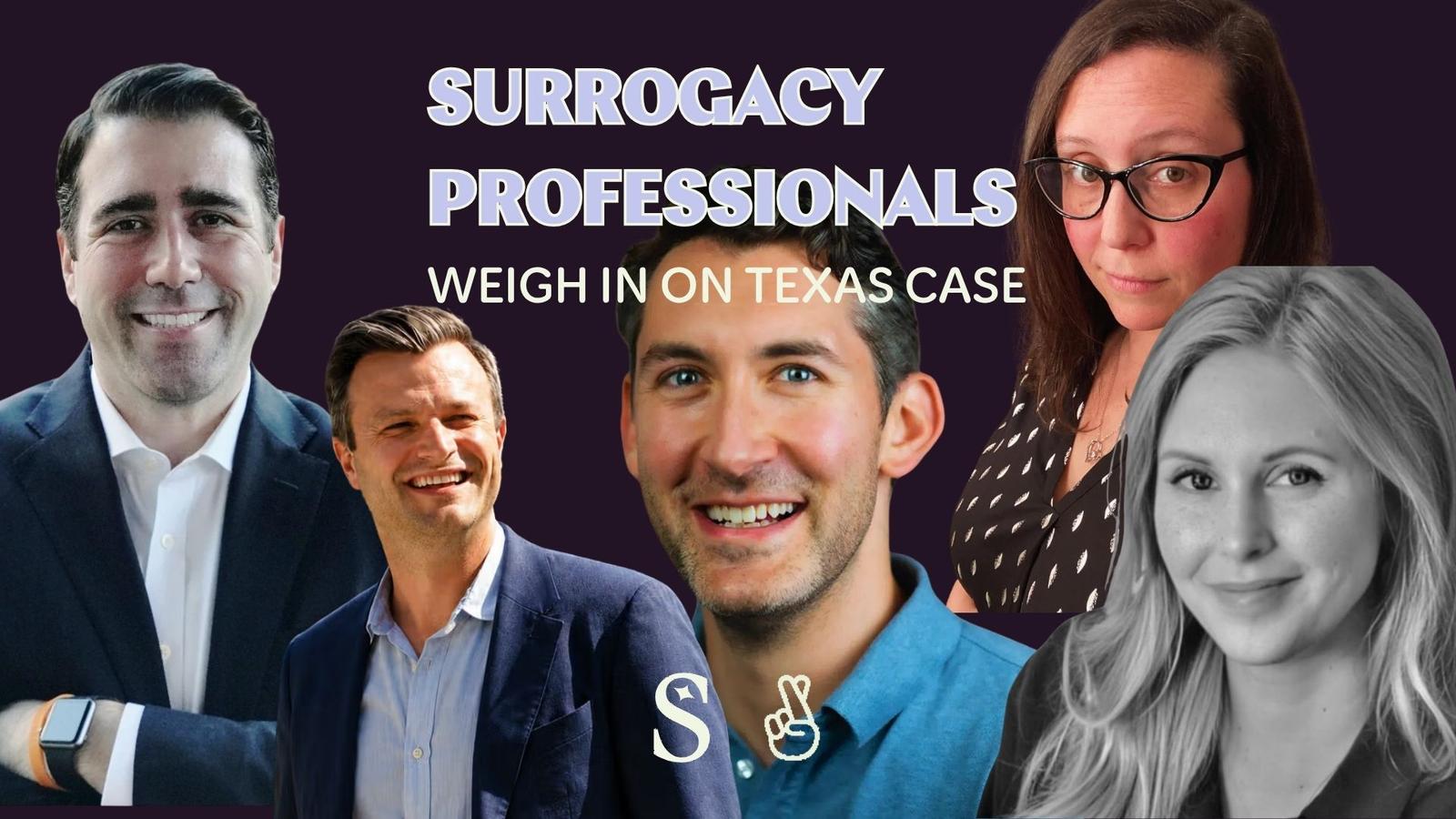
We asked four people who work inside this process every day to respond: an attorney, a mental health professional, an agency owner, and a former surrogate. Two are Magic Makers, one leads publications at the National Surrogate Alliance, and two are parents through surrogacy themselves. They are not neutral, and neither are we. They also do not agree with each other, and we are not going to pretend otherwise.
Ryan Ferrante, a surrogacy attorney at The Law Office of Ryan C. Ferrante, a parent through surrogacy, and a Magic Maker, described the process that exists to prevent exactly this kind of breakdown. This includes the screening, counseling, and independent legal review that happen before a transfer, so that a disagreement over termination is worked through in a room with professionals rather than in a courtroom two states away. Sound arrangements include psychological screening, medical screening, and independent legal consultation, he said, with "detailed conversations about potential termination of pregnancy" and "diligent efforts to document the desires and intentions of the parties." But he was equally clear about where the line sits: "in all cases, all parties acknowledge and understand that the final decision on termination rests with the gestational surrogate." The contract does not override her bodily autonomy. What it governs is disclosure, shared decision-making, and parentage.
Portia Zwicker, who is the Publications Lead at the National Surrogate Alliance, consults on NY surrogacy agency law and is a former gestational surrogate. She put the same point from the other side. "Being a surrogate doesn't mean you become the parent of the child you're carrying," she said. "At the same time, you don't stop being a person with bodily autonomy simply because you've entered into a surrogacy agreement." She is candid that she doesn't feel she knows the full timeline, and she is blunt about the fallout she expects: less trust between parties, and more intended parents refusing to match with carriers who won't terminate, or with carriers in abortion-restrictive states. That makes matching with a surrogate harder for everyone.
Nicole Adams, a mental health professional, Magic Maker, and Director of Clinical Services at Thallo Health - the largest mental health provider in surrogacy - offered the most useful caution in the group. No amount of screening makes this risk zero. "Agreeing to a theoretical scenario during a match meeting or a screening or even when contracts are finalized does not guarantee that all of the variables will remain constant throughout a pregnancy," she said. "People do change their minds. That is part of being human." Her recommendation is not tighter contracts but better matching. A carrier with real reservations about termination deserves intended parents who share them, and "forcing a match to align is dangerous."
She also reminded us of the one person nobody can quote: the child. He may one day read all of this.
Jarret Zafran, who owns a surrogacy agency called Brownstone in New York and is a parent through surrogacy, named the risk that brought all of us to the page. "One dramatic or sensationalized news story can cause panic and lead people to rush into making overreactive laws." He walked through how many times his agency raises these scenarios before a match — pre-match conversations, profiles, psychological evaluation, match meetings, group psych sessions, contracts — and said he has no reason to believe that didn't happen here.
His point about coverage is the one I keep returning to. The American Society for Reproductive Medicine’s (ASRM) policy report on gestational surrogacy shared that the data gathering organization on embryo transfers, SART, reported nearly 11,515 embryo-transfer cycles involving gestational carriers in 2023 alone. The overwhelming majority of those pregnancies are, in Zafran's words, "boring in the best way." Nobody writes about them. So the public's entire picture of surrogacy is assembled from the handful of cases that went wrong.
What worries me
I'll be direct as that is my default mode. The surrogacy community is not ready for this fight.
Well-funded organizations with a clear political agenda moved quickly here. ADF had a legal playbook ready with coordinated messaging. McKenna West was relocated to a state where the legal landscape favored the argument. Within days, even neutral and liberal-leaning outlets were using a name chosen by anti-surrogacy advocates instead of the name on the birth records. That is not an accident. That is a campaign.
Consider who showed up. Ken Paxton intervened amid his campaign for one of Texas's U.S. Senate seats, and issued statements about "baby Gabriel" before the child was born. And listen to how West's own attorney, Lincoln Davis Wilson, describes a termination clause that appears in standard surrogacy contracts across the country: "The law doesn't permit hit man contracts, and this is a hit man contract." That is not a claim about this contract. It is a claim about every contract, which is the point.
And here is what that campaign is not about: McKenna West's wellbeing. When the news cycle moves on, and it will, she will navigate the aftermath alone. The organizations that moved her across the country, filed her petitions, and put her face on cable news will be onto the next case. These groups do not build support systems, just one-sided arguments.
They call themselves pro-family while working to dismantle the only path to parenthood available to millions of people. These are families navigating cancer, MRKH, lupus, endometriosis and other causes of infertility.
The asymmetry is the part people underestimate. There is no pro-surrogacy equivalent of the Heritage Foundation, Stop Surrogacy Now, Them Before Us, or ADF. There is no entity with that funding, messaging infrastructure, and political machinery working to protect access. The other side is actively surfacing difficult surrogacy and IVF cases from the past five years and investing in getting them covered. Ahmed and Gilkar are represented by private counsel, not a movement.
Meanwhile, in the last two weeks I've heard about multiple new initiatives forming in response. You can hear the passion and desire to make something happen, but also the uncertainty on the best path forward. Some want to throw money at the problem without consulting the people who know how fertility policy actually gets written. Others are positioning themselves as leaders in a space where they've never done the work.
We saw this exact pattern in adoption, where there were hard cases that produced reactive legislation. Reactive legislation produced restrictions that hurt the families who needed access most. The people closest to the work were drowned out by the people closest to the microphone.
Who we should be listening to
Stephanie Jones, through Michigan Fertility Alliance and State Strong, was pivotal in reversing Michigan’s 37 year surrogacy ban. She organized testimony and messaging strategy for the recent Texas legislative hearings. She and her State Strong co-founder Miraya Gran work with the small number of people who actually write fertility policy in this country, and they have the track record to move legislation. They are now forming the State Strong Surrogacy Consortium.
I am asking everyone in this space, whether it’s agencies, clinics, nonprofits, parent organizations, or professional groups, to set aside ego and rally behind the people with the experience to lead. Our common interest is state-level policy with real protections for intended parents, gestational carriers, and children. We don’t care who gets credit or who gets quoted.
Where The Surrogacy Foundation stands, and what we're asking
Our position is that the village should guide the implementation of protections in surrogacy that align with the best practices we know work in realtime. There are many people who have devoted their lives and careers to ensuring surrogacy in the U.S. remains accessible, ethical and child-centered. That is why we built Magic Makers with professionals from every corner of this field, and why the National Surrogate Alliance exists. Better protections and laws make surrogacy stronger and the process safer for everyone involved.
However, you cannot move legislation on clear messaging and position papers alone. It is the stories from the families who lived it, the surrogates who carried it, and the professionals who guided the process that provide the evidence to support the messaging and positioning papers. It is about real people with real names who can look a legislator in the eye and say this is what surrogacy actually looks like.
TSF's role in this fight is to be the hub for those stories. We are building a place where intended parents, gestational carriers, surrogacy-conceived adults and professionals can share their experiences and put them in the hands of the people on the front lines. Share yours now!
One extraordinary case should not define surrogacy for the tens of thousands of families and carriers who navigate it every year. It will, if we let it.
The families who need this path do not have the luxury of waiting for our community to get organized. The window is not going to stay open.
Zach French is an intended parent and the Executive Director of The Surrogacy Foundation, a nonprofit expanding accessibility to surrogacy through education, grants, and community.
How we sourced this: facts are drawn from court filings, sworn testimony at the August 25 hearing before Judge Ashley Wysocki, and statements by attorneys for both parties as reported by The Texas Tribune, CBS News, KERA News, CNN, and The Dallas Morning News, NBC News, and The Hill. HLHS prevalence is from the CDC; five-year transplant-free survival from a 2024 review; the 35-year figure from a 2025 JACC study following 2,012 children through staged reconstruction, which notes survival has improved across successive eras. Gestational carrier cycle data is from ASRM, citing SART. Proceedings were sealed on August 25. Judge Wysocki ruled on September 2; the terms became public only through West's September 9 Supreme Court filing. Justice Kagan denied West's emergency application on September 22. Where accounts conflict, we have said so. Commentary was contributed directly to The Surrogacy Foundation and is published with permission. Disclosures: Ryan Ferrante and Nicole Adams are Magic Makers, members of The Surrogacy Foundation's professional collective. Portia Zwicker is Publications Lead at the National Surrogate Alliance, a surrogate-led initiative incubated by The Surrogacy Foundation. Video versions of each response are on our Instagram.